

 Frederick Victor
New York City is surrounded by water. The Hudson River runs along its western edge, the East River cuts between Manhattan and Brooklyn and Queens, and the harbor opens wide to the south. For most of the 1800s, the only way to cross these waterways was by ferry. That worked fine when the city was smaller. But as New York grew into one of the busiest cities in the world, ferries simply couldn’t keep up.
The push for bridges began in the early 19th century. Petitions and proposals were floating around as early as 1802, with city planners and residents arguing that permanent crossings were essential for trade, transportation, and the movement of workers between neighborhoods. For decades, nothing happened. The engineering required to span wide, deep, ship-filled waterways was beyond what builders could reliably pull off.
That changed in the second half of the 1800s. New materials — especially steel — became available at a large scale for the first time. New techniques for laying foundations underwater were developed. And the city’s population was exploding, making the need impossible to ignore any longer.
Construction on New York’s first major bridge broke ground in 1870. It was a project unlike anything attempted in the United States at that point. Workers descended into pressurized underground chambers beneath the riverbed, digging through mud and rock by hand. Engineers designed towers that rose higher than almost every building in the city. The work took years, cost far more than planned, and claimed the lives of workers along the way.
But it worked. And once it did, the city didn’t stop. More bridges followed in the years after — each one bigger, faster to build, and shaped by the lessons learned from the one before it. Within roughly four decades, New York had transformed from a city dependent on ferries into one connected by some of the most ambitious steel structures ever built.
#1 Hell’s Gate Bridge (Queens and Randall’s Island), 1915
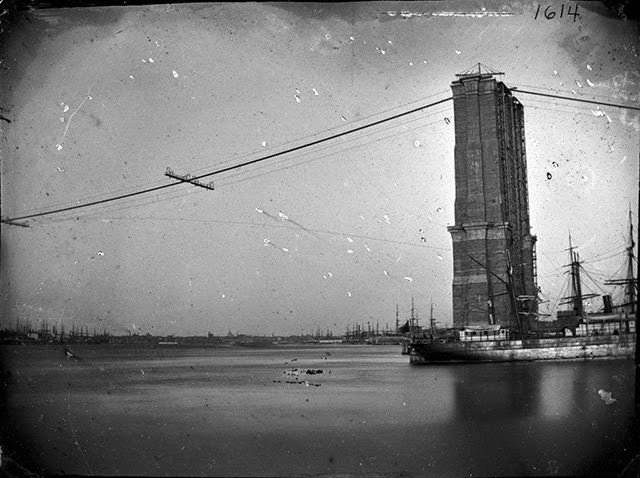
The Brooklyn Bridge, originally known as the East River Bridge, was one of the greatest engineering feats of the nineteenth century. Construction began in earnest in the early 1870s under the leadership of John Roebling and later his son, Washington Roebling. To build the massive foundations, workers used caissons, which were giant wooden boxes sunk to the riverbed. Laborers, known as sandhogs, dug out mud and rock from inside these pressurized boxes. This work was dangerous, as many men suffered from the bends when they returned to the surface too quickly. The bridge towers were built using limestone, granite, and Rosendale cement. These towers reached 276 feet into the air. Once the stone towers were finished, workers began the long process of spinning the four main cables. They used over 14,000 miles of steel wire to create the strength needed to hold the weight of the massive suspension bridge.
#2 Manhattan Bridge, 1909
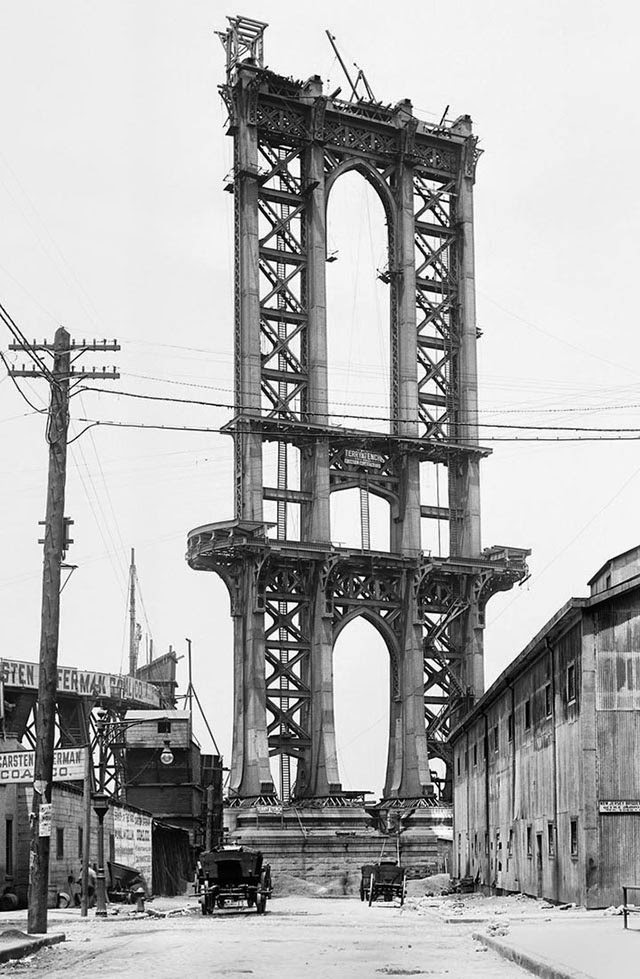
Completed in 1909, the Manhattan Bridge was the third suspension bridge built across the lower East River. This project is famous for being the first to use "deflection theory" in its design. This engineering method allowed the bridge to be lighter and more flexible than older structures while still being incredibly strong. Leon Moisseiff designed the bridge to handle heavy loads, including several subway lines and vehicle lanes. Unlike the stone towers of the Brooklyn Bridge, the Manhattan Bridge features two massive steel towers. These towers were much faster to assemble and provided a more modern look. Workers installed a Warren truss system along the roadway to keep it stable during high winds and heavy traffic. This bridge served as a model for many of the large suspension bridges built across the United States throughout the twentieth century.
#3 Williamsburg Bridge, c. 1900-1906
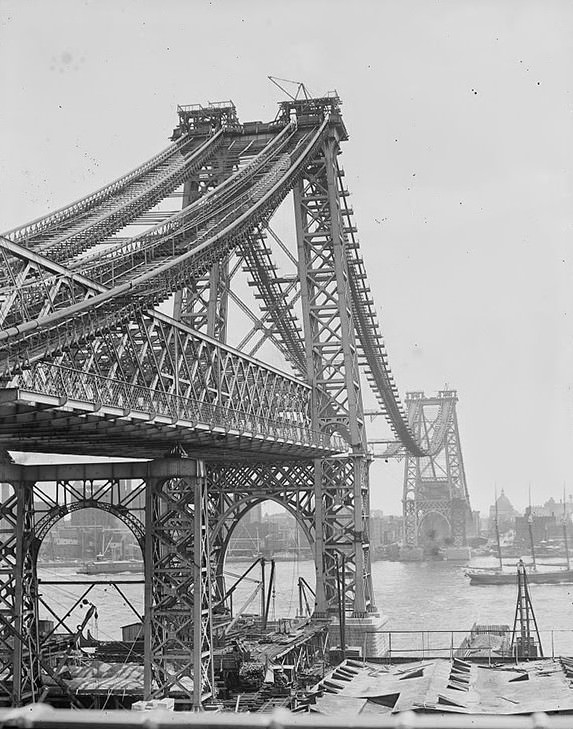
The Williamsburg Bridge was built between 1900 and 1906 to provide a new route between Manhattan and Brooklyn. At the time of its completion, it was the longest suspension bridge in the world. Engineers designed it with massive steel towers that sit on masonry foundations. These towers support four main cables, each made of thousands of parallel steel wires. Unlike the cables on the Brooklyn Bridge, these were not wrapped in a specific way, which allowed them to be finished faster. The bridge was originally designed to carry a mix of trolley cars, elevated trains, and horse-drawn carriages. Because it used so much exposed steel, the bridge has a very industrial appearance compared to its neighbors. It required nearly 18,000 miles of wire to complete the suspension system. This bridge was essential for moving the growing population out of crowded city centers.
#4 Kosciuszko (Meeker Avenue) Bridge, 1939
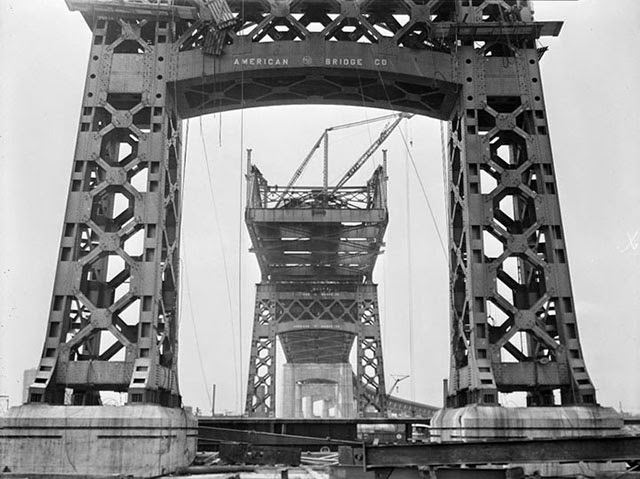
The Kosciuszko Bridge, originally called the Meeker Avenue Bridge, opened in 1939 to connect Brooklyn and Queens. It was a through-truss bridge, meaning the road went through the middle of the steel framework. Construction crews built the bridge with a high clearance of 125 feet to allow ships to pass underneath on Newtown Creek. This required building long, steep approach ramps on both sides of the water. Workers used millions of steel rivets to piece together the complex truss system. The bridge was part of a major highway project designed to improve traffic flow between the two boroughs. In 1940, the city renamed the bridge to honor General Tadeusz Kosciuszko, a hero of the American Revolution. The original steel structure served the city for decades before it was eventually replaced by a modern cable-stayed bridge.
#5 Hamilton Avenue Bridge (Gowanus Canal), 1933
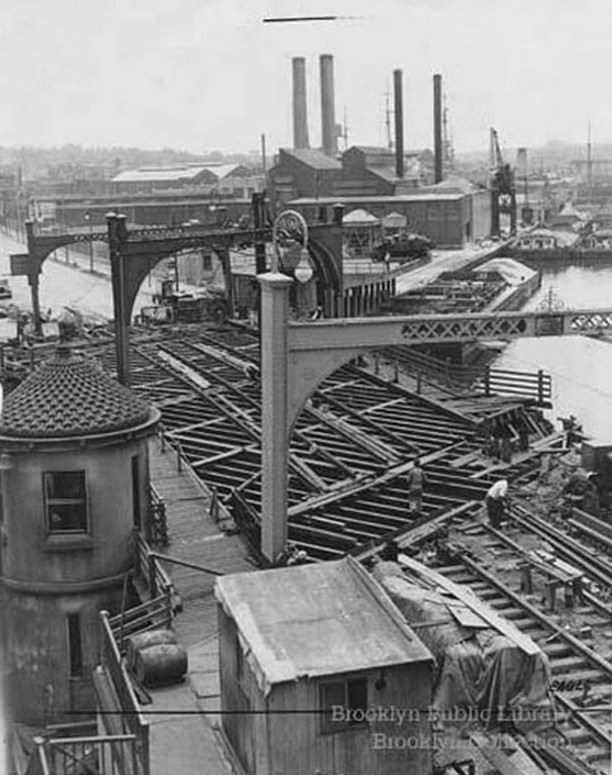
The Hamilton Avenue Bridge is a critical link over the Gowanus Canal in Brooklyn. Completed in 1933, this bridge uses a "bascule" design, which is a type of drawbridge. It features two separate leaves that tilt upward to allow tall ships to pass through the industrial canal. Each leaf is balanced by a massive concrete counterweight hidden beneath the roadway. When a ship needs to pass, large electric motors engage gears that lift the heavy steel decks. This bridge was built during a time when the Gowanus Canal was one of the busiest commercial waterways in the country. Construction crews had to work carefully around the active shipping traffic. The bridge handles thousands of trucks and cars every day, providing a direct route to the busy waterfront docks and warehouses.
#6 155th Street Viaduct (The Riviera)
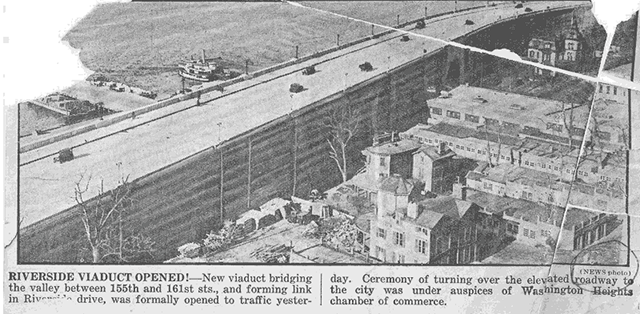
The 155th Street Viaduct, often called "The Riviera" because of its grand design, was built to connect the high ground of Washington Heights to the Macombs Dam Bridge. Workers constructed this elevated roadway in the late nineteenth century using heavy steel girders and stone retaining walls. The viaduct stands high above the valley, allowing travelers to bypass the steep hills of northern Manhattan. Engineers used ornamental ironwork and decorative railings to give the structure a sophisticated look. The construction required moving tons of earth and building massive stone piers to support the road. It provided a vital link for horse-drawn carriages and early automobiles. The viaduct offers a wide view of the Harlem River and was considered one of the most beautiful pieces of infrastructure in the city when it opened.
#7 Henry Hudson Bridge (Spuyten Duyvil Creek), 1936
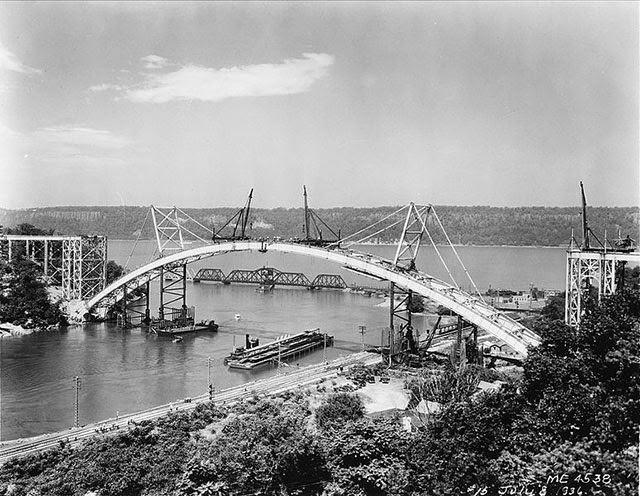
The Henry Hudson Bridge spans the Spuyten Duyvil Creek at the northern tip of Manhattan. Opened in 1936, it is a fixed steel arch bridge with two levels of traffic. The bridge was a key part of the Henry Hudson Parkway project led by Robert Moses. At the time it was built, its 800-foot main span was the longest hingeless arch in the world. Construction crews had to build the bridge on high rocky cliffs, which made the work difficult and dangerous. They used a specific type of steel called "silicon steel" to provide extra strength without adding too much weight. The upper deck was added shortly after the lower deck was finished to handle the high volume of cars moving toward the Bronx. Its sleek, green-painted arch blends into the surrounding parkland and river scenery.
#8 High Bridge (Harlem River), 1927
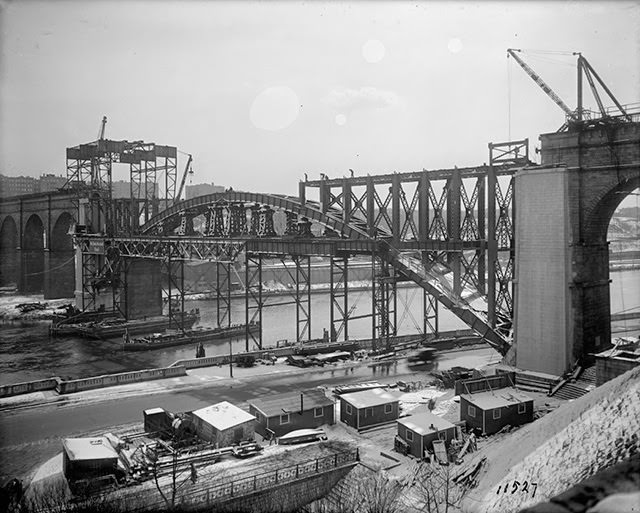
The High Bridge is the oldest bridge in New York City, originally built in 1848 as part of the Croton Aqueduct. However, it underwent a major construction change in 1927. Originally, the bridge was made entirely of stone arches. To improve navigation on the Harlem River, the War Department ordered that several of the stone piers be removed. Engineers replaced five of the original stone arches with a single, long steel arch that spans 450 feet. This allowed large naval vessels and commercial ships to pass through the center of the river without risk of hitting the bridge. Workers had to carefully support the remaining stone sections while they installed the new steel framework. The bridge stopped carrying water in the mid-twentieth century and now serves as a popular pedestrian path between Manhattan and the Bronx.
#9 Outerbridge Crossing (Arthur Kill), 1927
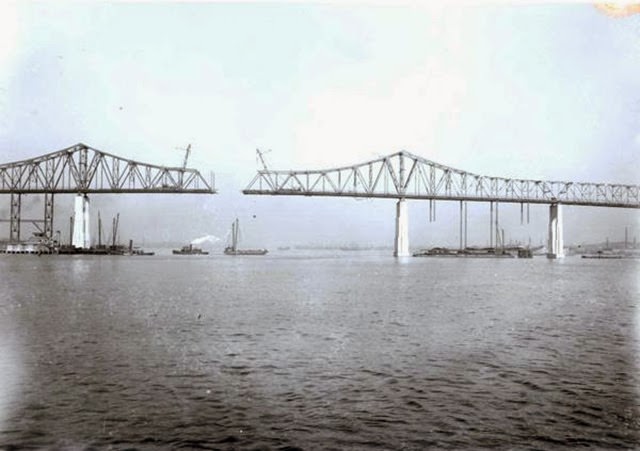
The Outerbridge Crossing opened in 1927 to connect Staten Island to Perth Amboy, New Jersey. It is a massive cantilever bridge, which means it uses anchored arms to support the center span. The bridge was named after Eugenius Outerbridge, the first chairman of the Port of New York Authority. Construction crews built the bridge high above the Arthur Kill to ensure that large ocean-going tankers could pass underneath. They used a complex truss system made of thousands of tons of steel beams. The bridge is over 10,000 feet long when including the approach ramps. It was built at the same time as the Goethals Bridge as part of a plan to make Staten Island more accessible. The Outerbridge Crossing remains a vital route for heavy trucks and commuters moving between the two states.
#10 Wards Island Bridge (Harlem River), c. 1950
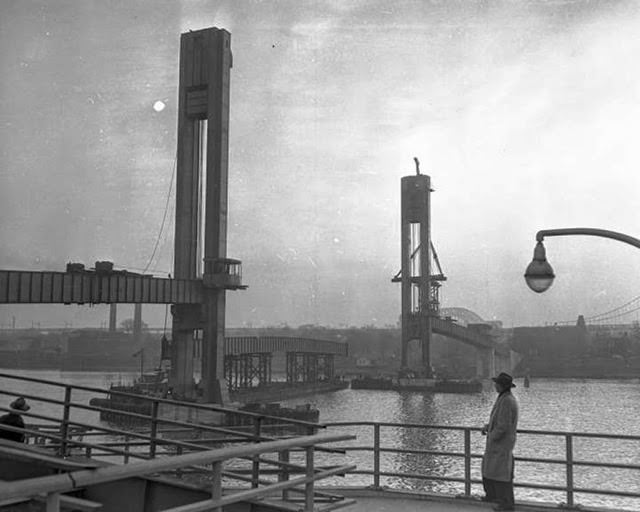
The Wards Island Bridge, also known as the 103rd Street Footbridge, was completed around 1950. It is a pedestrian bridge that connects East Harlem in Manhattan to Wards Island Park. The bridge features a vertical lift design. This means the entire center section of the bridge rises straight up between two tall steel towers. This allows the bridge to stay close to the water for people walking or biking while still letting large ships pass underneath. Engineers installed large pulleys and counterweights inside the towers to move the heavy center span. The construction was intended to give city residents more access to the green spaces and hospitals on the island. It is one of the few bridges in the city designed exclusively for people rather than cars or trains.
#11 Washington Bridge (Harlem River)
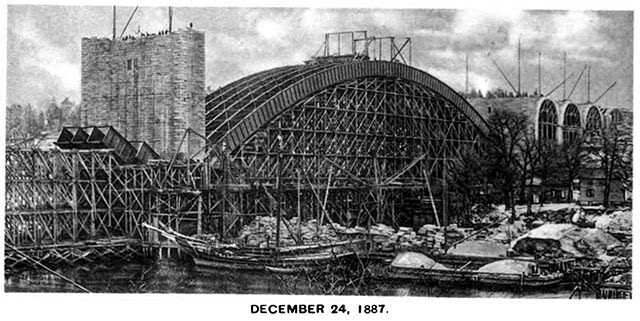
The Washington Bridge is a historic structure that connects 181st Street in Manhattan to the University Heights section of the Bronx. Completed in 1889, it features two massive steel arches that span the Harlem River and the nearby railroad tracks. Each arch is over 500 feet long and is supported by heavy granite piers. The design was influenced by the elegant bridges of Europe, featuring ornate iron railings and detailed stonework. Workers had to build the arches using a method that allowed them to meet in the middle with perfect precision. The bridge was originally built for horse-drawn traffic and pedestrians, but it was later strengthened to handle modern cars and buses. Its high position provides a clear view of the Harlem River valley and the High Bridge to the south.
#12 Queensboro Bridge (Blackwell’s Island Bridge), 1907
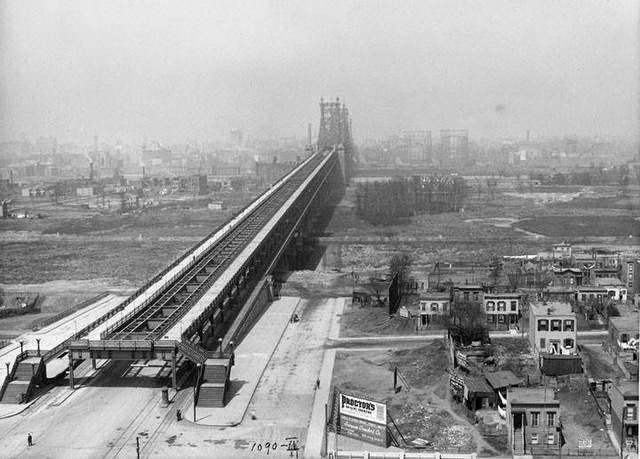
The Queensboro Bridge, often called the 59th Street Bridge, was finished in 1907. It is a double-deck cantilever bridge that connects Midtown Manhattan to Long Island City. The bridge crosses over Roosevelt Island, which was known as Blackwell’s Island during construction. It consists of five separate spans supported by massive steel towers. Engineers used 75,000 tons of steel to build the framework, which was designed to carry heavy trains on the lower deck and vehicles on both levels. The construction was complex because the bridge had to be built in sections from both sides of the river simultaneously. Workers used a huge "traveler" crane to lift the steel beams into place. The bridge provided the first direct land connection between Manhattan and the rapidly growing borough of Queens.
#13 Hell’s Gate Bridge (Queens and Randall’s Island), 1915
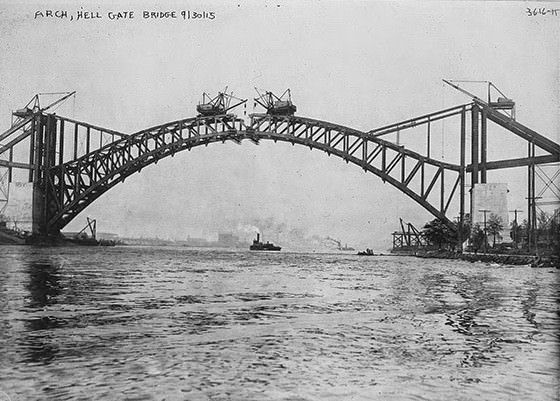
The Hell’s Gate Bridge was completed in 1915 to serve as a vital link for the New York Connecting Railroad. It features a massive steel arch that spans 1,017 feet across a dangerous stretch of water known for its whirlpools and currents. Engineers chose the arch design because it could support the extreme weight of heavy freight trains. The construction required 19,000 tons of steel. Workers used granite-faced concrete towers to anchor the ends of the arch. These towers are not just for looks; they provide the weight needed to keep the arch stable. The bridge was built with such accuracy that the two halves of the arch were only a fraction of an inch off when they were joined in the middle. It served as the inspiration for the world-famous Sydney Harbour Bridge.
#14 Verrazzano-Narrows Bridge, 1963
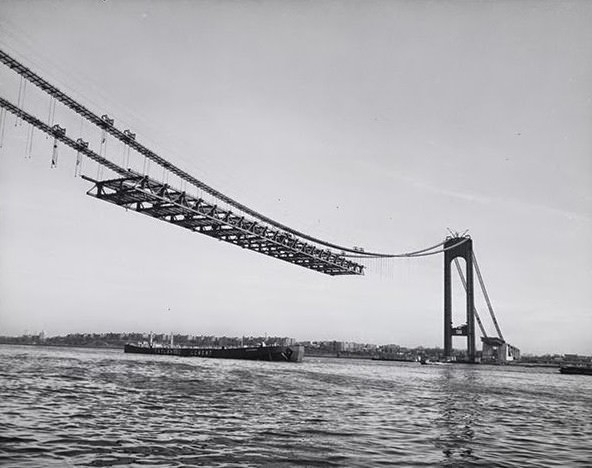
The Verrazzano-Narrows Bridge opened in late 1964 after more than five years of construction. It connects Brooklyn and Staten Island at the mouth of New York Harbor. Because the bridge is so long, engineers had to account for the curvature of the earth when building the towers. The tops of the two 693-foot steel towers are 1.6 inches farther apart than their bases. Workers used 143,000 miles of steel wire to spin the four main cables that support the road. The bridge features two decks for vehicle traffic, making it one of the busiest crossings in the world. During construction, giant cranes lifted massive steel sections from barges and moved them into place high above the water. It was the longest suspension bridge in the world when it opened and remains a symbol of modern New York engineering.

GIPHY App Key not set. Please check settings